
 EN
EN

How Much Are HGS Road Tolls in Istanbul? Complete Guide to Istanbul Toll Fees
HGS Toll Fees in Istanbul 2026
How Much Are Highway and Bridge Tolls in Turkey in 2026?
Istanbul is one of the world’s most popular and busiest destinations for travel and sightseeing. With so many tourist attractions, it is impossible to explore everything in a single trip. Historic and religious sites, museums, lush forests, and the sea all come together to make Istanbul a unique and fascinating destination. Every year, thousands of visitors from European and Asian countries travel to Istanbul.
Due to the city’s vast size, the number and spread of its tourist attractions, and the high cost of taxi fares, renting a car has become a common choice for getting around Istanbul. Therefore, having sufficient information about Istanbul’s traffic regulations and highway tolls, known as HGS, can help drivers manage their travel expenses more effectively.
Stay with us as we introduce the 2026 toll fees for Istanbul’s main highways and bridges and provide useful information to help you better understand HGS charges in Istanbul.
Highway and bridge tolls are among the topics most frequently searched by vehicle owners, especially during holiday periods. However, toll fees can vary significantly depending on the type of vehicle. Therefore, understanding the different vehicle classes is essential for accurately estimating toll costs.
What Are the Different Vehicle Classes?
Class 1 Vehicles: Vehicles with a wheelbase of less than 3.20 meters. Most passenger cars, as well as small and medium-sized vans, fall into this category. Class 1 vehicles make up the largest share of vehicles on the roads.
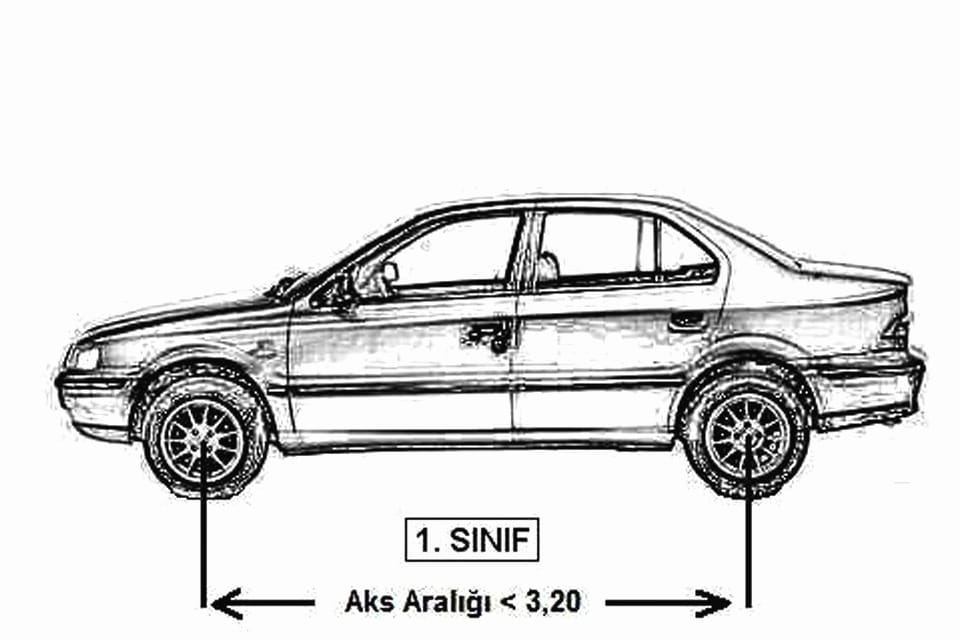
Class 2 Vehicles: Two-axle vehicles with a wheelbase of more than 3.20 meters. This category mainly includes commercial and cargo vehicles, light passenger vehicles, and large vans.
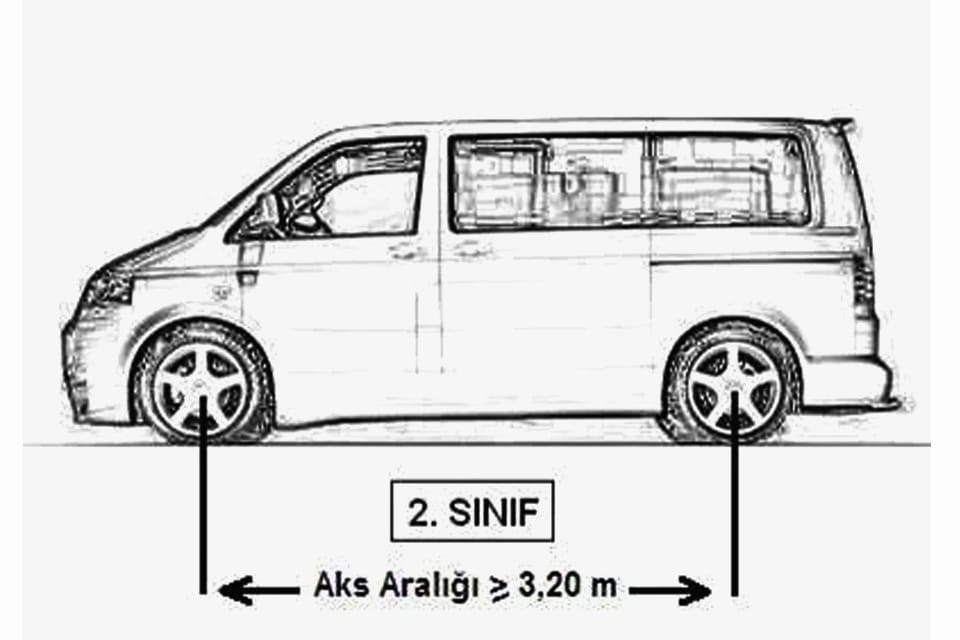
Class 3 Vehicles: All vehicles with three axles, such as buses.
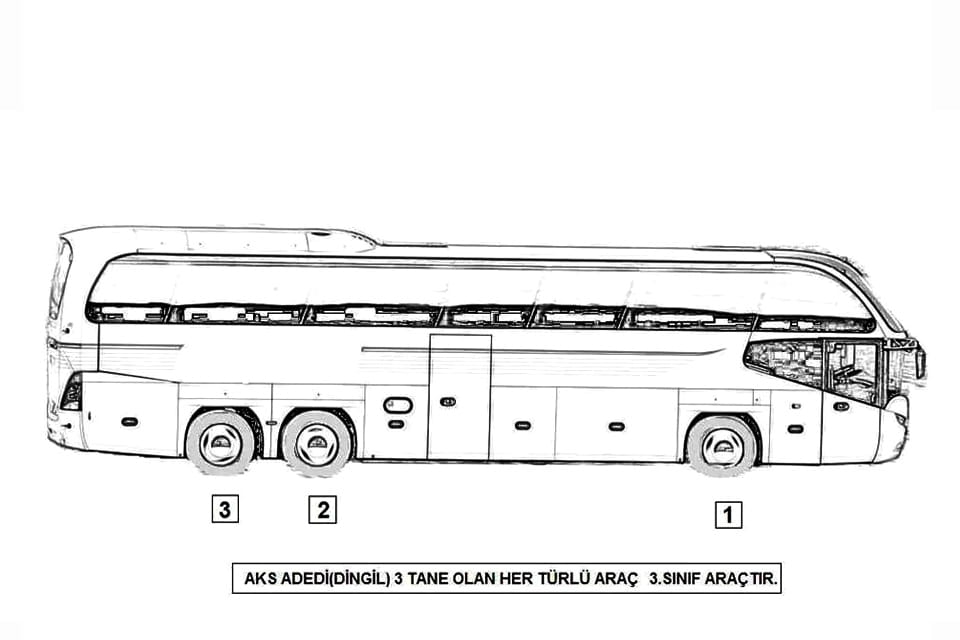
Class 4 Vehicles: All vehicles with four or five axles.
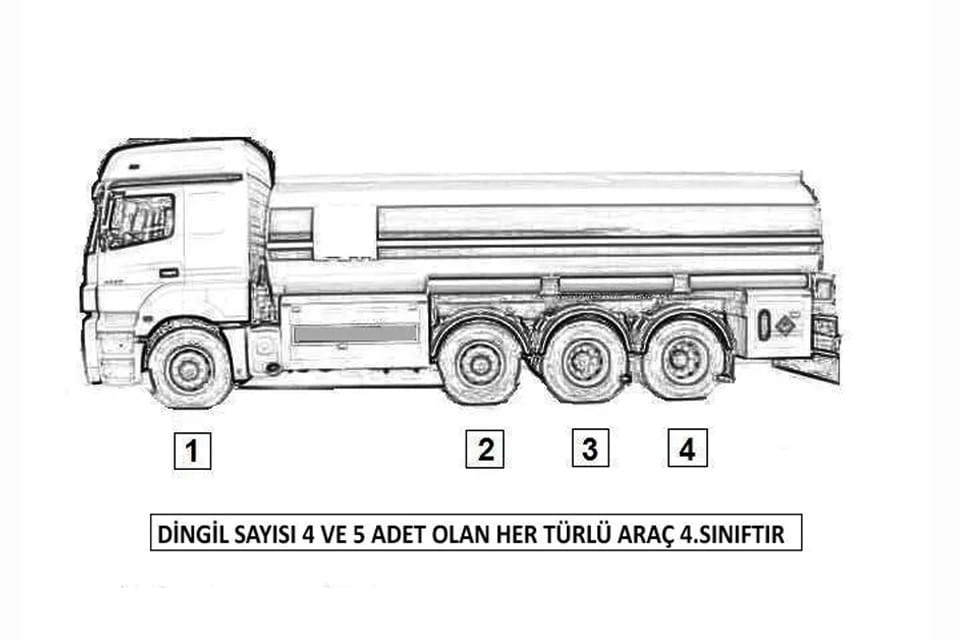
Class 5 Vehicles: All vehicles with six axles.
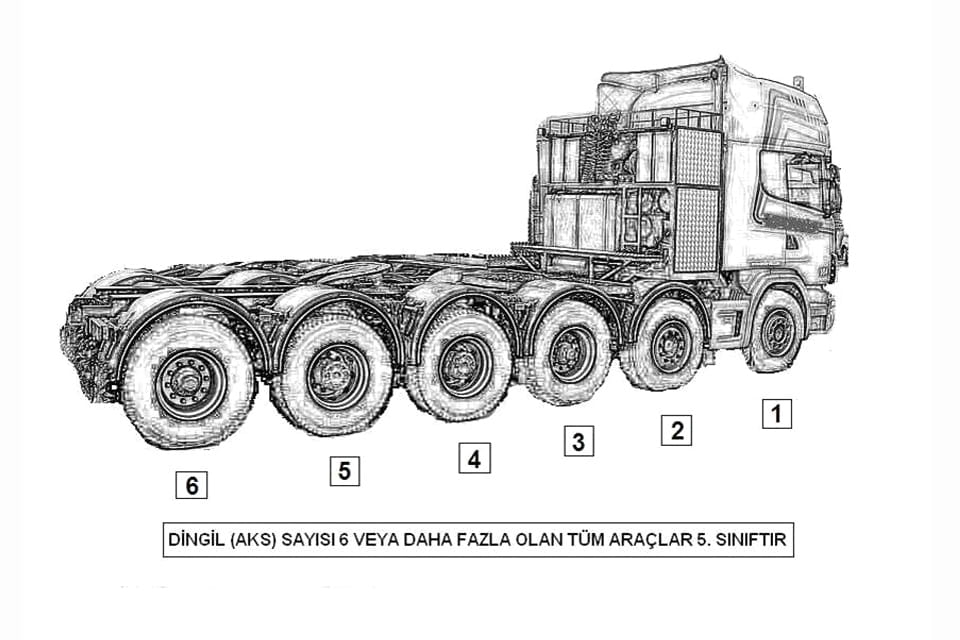
Class 6 Vehicles: Motorcycles.
Vehicle Classification for HGS Toll Calculation
Toll fees in Turkey are determined based on the vehicle class.
Class 1
Two-axle vehicles with a wheelbase of less than 3.20 meters.
Most passenger cars, sedans, hatchbacks, and many SUVs fall into this category.
Class 2
Two-axle vehicles with a wheelbase of 3.20 meters or more that are classified in this category according to the regulations.
Class 3
All vehicles with 3 axles.
Class 4
Vehicles with 4 or 5 axles.
Class 5
Vehicles with 6 or more axles.
Class 6
Motorcycles.
This classification is also used in official Turkish toll system regulations.
Toll Fees for Bridges, Highways, and the Eurasia Tunnel
If you are planning to drive or rent a car in Istanbul, understanding the HGS system and the toll fees for bridges, highways, and toll tunnels can help you manage your travel expenses more effectively.
Because Istanbul is located across two continents, Europe and Asia, the city has several bridges, highways, and toll routes connecting the two sides. When passing through certain routes, toll fees are collected electronically through HGS (Hızlı Geçiş Sistemi).
The latest major toll tariffs for 2026 came into effect on July 1, 2026. However, some state-operated routes, including the 15 Temmuz Şehitler Bridge and Fatih Sultan Mehmet Bridge, were not affected by this price increase.
Toll Fees on Istanbul’s Highways and Motorways
It is incorrect to assume that all highways and motorways in Istanbul require toll payments. Only certain major toll routes, bridges, and crossings are subject to toll charges. These include the following:
What Is HGS?
HGS stands for Hızlı Geçiş Sistemi, which means “Fast Passage System.”
HGS is an electronic toll collection system used for roads, highways, and bridges in Turkey. When a vehicle passes through an HGS-equipped toll point, the vehicle is identified electronically and the applicable toll fee is deducted from its HGS account.
Therefore, in most toll areas, drivers do not need to stop to make a cash payment.
Is OGS Still Used in Turkey?
No. OGS is no longer an active toll payment system in Turkey and was discontinued in 2022. Therefore, if you are traveling by car in Turkey in 2026, HGS is the primary electronic toll payment system.
HGS and Istanbul Bridge Toll Fees in 2026
One of the most important points for tourists is that HGS does not have a fixed fee. The amount deducted from an HGS account depends on the route, bridge, tunnel, and vehicle class.
For passenger cars, most standard vehicles fall into Class 1.
2026 Toll Rates for Istanbul’s Main Bridges
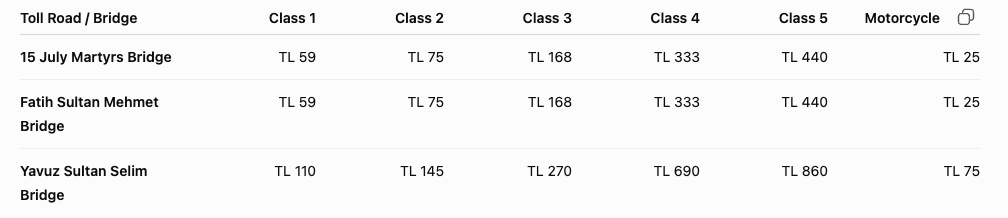
Toll Fees for the 15 Temmuz Şehitler Bridge in Istanbul
The 15 Temmuz Şehitler Köprüsü, formerly known as the Bosphorus Bridge, is one of the main routes connecting the European and Asian sides of Istanbul.
2026 toll rates:
- Class 1: 59 TL
- Class 2: 75 TL
- Class 3: 168 TL
- Class 4: 333 TL
- Class 5: 440 TL
- Motorcycles: 25 TL
Since 2022, tolls on this bridge have been collected in both directions. Therefore, if you cross the bridge and return by car, a Class 1 vehicle will pay a total of 118 TL in toll fees.
Which Vehicles Can Use the 15 Temmuz Şehitler Bridge?
Class 1 vehicles, certain service vehicles, public transportation vehicles, and other authorized vehicles can use this bridge. Some heavy vehicles and vehicles subject to traffic restrictions must use other designated routes, particularly the Yavuz Sultan Selim Bridge.
Toll Fees for the Fatih Sultan Mehmet Bridge in 2026
The Fatih Sultan Mehmet Bridge (FSM) is the second major bridge in Istanbul connecting the city’s European and Asian sides.
2026 toll rates:
- Class 1: 59 TL
- Class 2: 75 TL
- Class 3: 168 TL
- Class 4: 333 TL
- Class 5: 440 TL
- Motorcycles: 25 TL
Tolls on this bridge are also collected in both directions. Therefore, the round-trip toll for a Class 1 vehicle is 118 TL.
It is important to note that not all vehicles are permitted to use the FSM Bridge. Restrictions based on vehicle type and the number of axles must be taken into consideration.
Class 1 vehicles, Class 2 vehicles (except trucks and buses), service vehicles (tourist, staff, school, etc.), caravans, public transportation vehicles (IETT and public buses, company buses, taxis, etc.), and official-plated service vehicles operated by authorized public institutions and organizations of the General Directorate of Highways (KGM) are permitted to use the bridge.
Toll Fees for the Yavuz Sultan Selim Bridge in 2026
The Yavuz Sultan Selim Bridge, also known as Istanbul’s Third Bridge, is located in the northern part of Istanbul.
This bridge is particularly important for vehicles that are not permitted to use the 15 Temmuz Şehitler and Fatih Sultan Mehmet (FSM) bridges.
As of July 1, 2026, the toll rates are as follows:
- Class 1: 110 TL
- Class 2: 145 TL
- Class 3: 270 TL
- Class 4: 690 TL
- Class 5: 860 TL
- Motorcycles: 75 TL
Tolls on the Yavuz Sultan Selim Bridge are also collected in both directions.
For Class 2, 3, 4, and 5 vehicles, except for vehicles specifically authorized to use the other bridges, as well as vehicles carrying chemical and hazardous materials, using the Yavuz Sultan Selim Bridge is mandatory.
- All vehicle classes can use the Yavuz Sultan Selim Bridge. However, certain requirements and regulations apply to vehicles carrying special cargo, chemicals, and hazardous materials.
Toll Fees for the Fatih Sultan Mehmet Bridge in 2026
The Fatih Sultan Mehmet Bridge (Fatih Sultan Mehmet Köprüsü or FSM) is one of Istanbul’s most important bridges, connecting the European and Asian sides of the city. Like the 15 Temmuz Şehitler Bridge, it operates under the electronic HGS toll payment system.
According to the official tariff published by the General Directorate of Highways (KGM) and effective from January 1, 2026, the toll fees for crossing the Fatih Sultan Mehmet Bridge are as follows:

How Much Does a Round Trip Across the FSM Bridge Cost?
Since January 1, 2022, tolls on the Fatih Sultan Mehmet Bridge have been collected in both directions. Therefore, for a standard Class 1 passenger car:
59 TL outbound + 59 TL return = 118 TL
As a result, if a Class 1 vehicle crosses the FSM Bridge and returns across the same bridge during the same trip, the total toll will be 118 TL.
Which Vehicles Can Cross the Fatih Sultan Mehmet Bridge?
Class 1 vehicles are permitted to cross the bridge. In addition, certain Class 2 vehicles, excluding trucks and buses, as well as service vehicles, caravans, public transportation vehicles, and certain authorized official vehicles, may also use the bridge. Vehicles that are not permitted to use the FSM Bridge must use the Yavuz Sultan Selim Bridge.
Important Note for Rental Cars
If you rent a car in Istanbul, most standard passenger cars are classified as Class 1. Therefore, when crossing the Fatih Sultan Mehmet Bridge, a toll of 59 TL per direction will apply and will be collected through HGS.
Note: HGS toll rates may change during the year. Therefore, this section of the Rentifa article should be updated whenever KGM announces new toll rates. The official KGM website publishes the latest toll rates for bridges and highways in Turkey.
Toll Fees for the Osmangazi Bridge in 2026
The Osmangazi Bridge (Osmangazi Köprüsü) is one of Turkey’s most important toll bridges. Located over the Gulf of İzmit, it forms part of the Gebze–Orhangazi–İzmir highway. The bridge significantly shortens the travel time between Istanbul, Bursa, and İzmir.
Osmangazi Bridge Toll Rates in 2026
According to the latest announced tariff, toll fees for crossing the Osmangazi Bridge increased as of July 1, 2026. The rates are as follows:
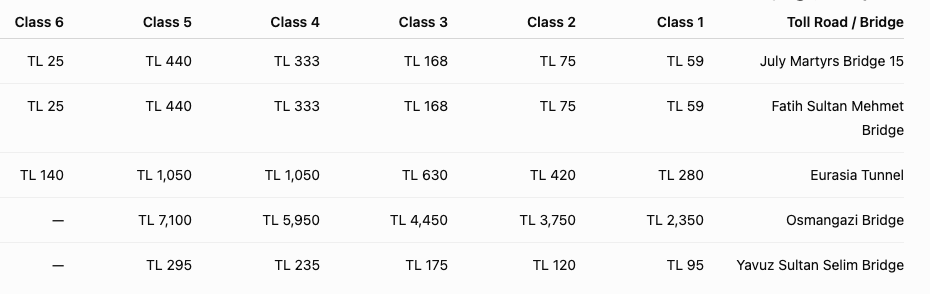
These amounts include Value Added Tax (VAT).
Vehicle Classes:
- Class 1: Cars
- Class 2: Minibuses and vans
- Class 3: 3-axle vehicles
- Class 4: 4-axle vehicles
- Class 5: 5-axle vehicles
- Class 6: Motorcycles
How Much Does It Cost for Passenger Cars?
If you cross the Osmangazi Bridge with a standard passenger car classified as Class 1, the bridge toll is:
1,170 Turkish Lira
It is important to note that this amount covers only the Osmangazi Bridge toll. If you continue on a toll highway, the highway fee is calculated separately. KGM also states that on the Istanbul–İzmir route, the bridge toll and highway toll are calculated separately.
How Much Was the Osmangazi Bridge Toll at the Beginning of 2026?
For comparison, the tariff that came into effect on January 1, 2026 was 995 TL for Class 1 vehicles. As of July 1, 2026, this amount increased to 1,170 TL.
This means that in 2026, the Class 1 vehicle toll increased from:
995 TL → 1,170 TL
How Are Osmangazi Bridge Tolls Paid?
Tolls are collected electronically through toll collection systems such as HGS. Therefore, if you are traveling by rental car from Istanbul to Bursa or İzmir, it is advisable to check with the rental car company before your trip to confirm that the vehicle’s HGS is active and to understand how the toll charges will be settled.
Latest update: The 1,170 TL toll for Class 1 vehicles has been valid since July 1,
Eurasia Tunnel Toll Fees in Istanbul 2026
The Avrasya Tunnel is one of the fastest routes connecting the European and Asian sides of Istanbul.
The tunnel passes beneath the Bosphorus Strait and is designed for light vehicles.
An important point is that the Eurasia Tunnel toll rates also increased on July 1, 2026. The current tariff is:
Vehicle Type Daily Rate. Nightly Rate
Class 1 Vehic. 330TL. 165TL
Class 2 Minibus. 495TL. 247.50TL
Motorcycle. 257.40TL 128.70TL
The nighttime tariff applies from 00:00 to 04:59.
The Eurasia Tunnel uses a Free Flow toll collection system, with payments made through HGS. Cash payments or direct bank card payments at a toll booth are not available at the tunnel. Vehicles with Turkish or foreign license plates can pay the toll through HGS or via the tunnel’s online payment system.
Which Vehicles Are Not Allowed to Use the Eurasia Tunnel?
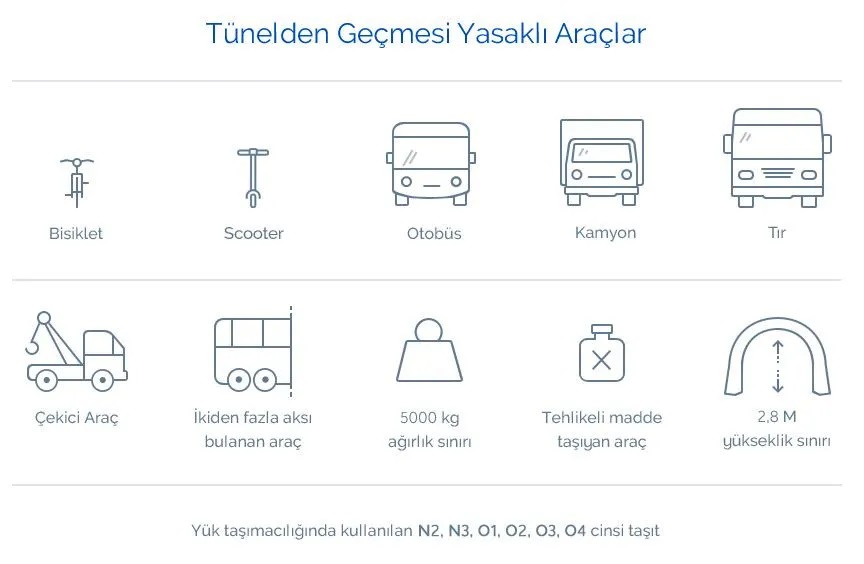
The following vehicles are prohibited from using the tunnel:
- Bicycles
- Motorcycles
- Buses
- Trucks
- Tractors
- Vehicles with more than two axles
- Vehicles weighing more than 5,000 kg
- Vehicles carrying hazardous materials
- Vehicles exceeding the maximum height limit of 2.8 meters
- Vehicles in categories N2, N3, O1, O2, O3, and O4 used for freight transportation
The vehicles prohibited from using the Eurasia Tunnel are listed below:
Toll Fees on Highways Around Istanbul in 2026
In addition to bridges, some highways around Istanbul also require toll payments. The exact highway toll depends on the entry point, exit point, and vehicle class, so there is no single fixed price for an entire route.
For Class 1 vehicles, some of the complete toll rates for major routes in 2026 are as follows:
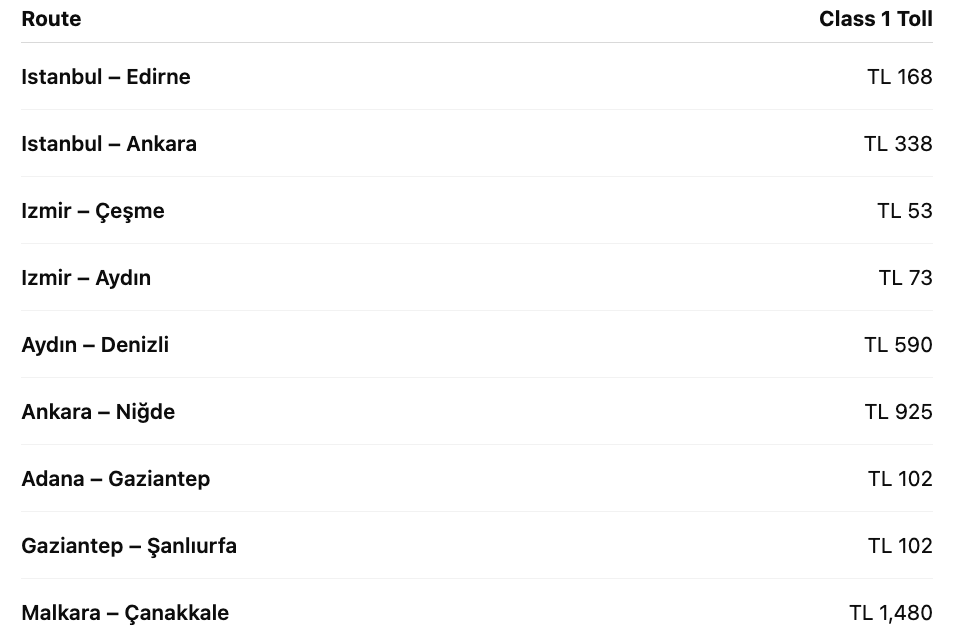
Important: Highway tolls are charged according to the section of road you use. Therefore, the actual HGS amount for your journey may be lower than the full-route figure shown above. For the most accurate calculation, check the specific entry and exit points on the official KGM toll schedule.
Are Istanbul HGS Tolls Doubled for Round Trips?
This depends on the route.
For example, the 15 Temmuz Şehitler, Fatih Sultan Mehmet, and Yavuz Sultan Selim Bridges charge tolls in both directions. Therefore, if you cross the 15 Temmuz Bridge and return in a Class 1 vehicle:
59 + 59 = 118 TL
However, on routes where tolls are calculated based on entry and exit points on a highway, the fee is determined according to the distance traveled and the entry and exit stations.
HGS for Rental Cars in Istanbul
If you plan to rent a car in Istanbul, it is advisable to ask the rental company about how HGS toll payments are handled before starting your journey.
In many rental cars, HGS is already activated on the vehicle, and highway and bridge tolls are calculated based on the vehicle’s usage.
When picking up the car, ask the rental company:
- Does the vehicle have an active HGS account?
- How are HGS charges calculated?
- Are toll fees charged separately?
- Are there any additional service fees or commissions?
- How can I view the records of bridge and highway crossings?
For tourists using a rental car, this is particularly important because passing through toll points without payment may result in outstanding charges or penalties.
What Happens If the HGS Balance Is Insufficient?
If the HGS balance is insufficient, the vehicle may be recorded as an İhlalli Geçiş (unpaid toll passage).
For vehicles with foreign license plates, the rules are stricter. The General Directorate of Highways (KGM) states that foreign-plated vehicles should have HGS and sufficient balance to cover toll payments in order to avoid penalties. If an unpaid passage is recorded, the outstanding amount can also be paid through official payment systems.
For foreign-plated vehicles, if outstanding tolls and unpaid HGS charges are not settled, travelers may encounter problems at the Turkish border when leaving the country.
Penalty for Unpaid HGS Tolls in Turkey
If a toll remains unpaid, it is advisable to settle it as soon as possible.
For the Eurasia Tunnel, if the outstanding amount is paid within 15 days, no penalty is applied. After that, under the applicable regulations, a penalty equal to the toll amount may apply between 15 and 45 days, while a higher penalty may be imposed after 45 days.
For foreign-plated vehicles, KGM also recommends checking and paying all outstanding HGS tolls and debts before leaving Turkey.
Are All Roads in Istanbul Toll Roads?
No.
The idea that you have to pay HGS tolls on all highways and roads in Istanbul is incorrect.
Many streets and urban routes in Istanbul are free of charge. HGS charges mainly apply to routes such as:
- Bridges connecting the European and Asian sides
- Certain intercity highways
- Kuzey Marmara Otoyolu
- Yavuz Sultan Selim Bridge
- Eurasia Tunnel
- Certain toll roads around Istanbul
Therefore, if you drive within the city without using toll routes, you will not necessarily incur HGS charges.
Are Roads Free During Official Holidays in Turkey?
Sometimes, the Turkish government announces free passage on certain highways and bridges operated by KGM during official holidays. However, this does not necessarily apply to all bridges, tunnels, private highways, or Build-Operate-Transfer (Yap-İşlet-Devret) projects.
For example, during Eid al-Adha (Kurban Bayramı) in 2026, KGM announced that highways under its management and the 15 Temmuz and FSM Bridges would be free during the specified period. However, the Yavuz Sultan Selim Bridge, Kuzey Marmara, Osmangazi Bridge, 1915 Çanakkale Bridge, and certain other projects continued to charge tolls.
Therefore, it is advisable to check the official announcement for the specific holiday before traveling.
Summary Table of HGS Costs in Istanbul 2026
For a standard Class 1 passenger car, the main toll costs you may encounter when traveling by car in Istanbul include:
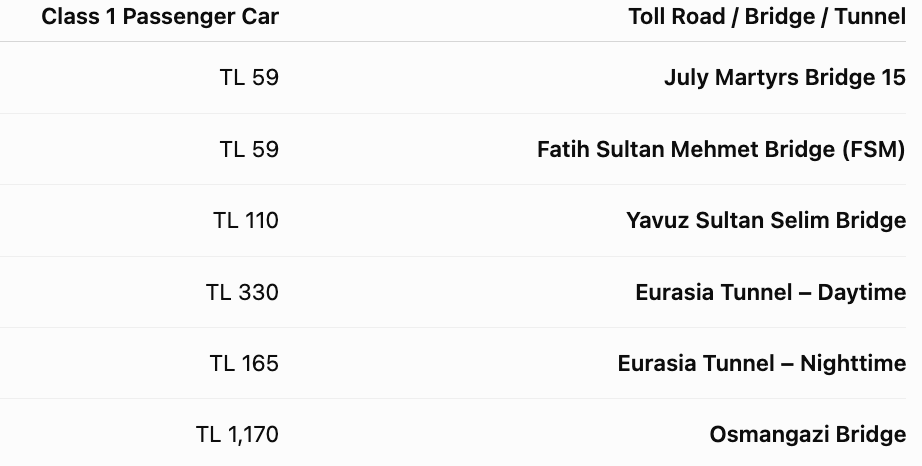
The toll rates above are for 2026 and are based on the latest available information as of August 2026. However, toll rates may change during the year.
Frequently Asked Questions About HGS in Istanbul
What Is HGS in Istanbul?
HGS is Turkey’s electronic toll payment system, used for crossing bridges, highways, and certain toll tunnels.
How Much Does HGS Cost in Istanbul?
HGS does not have a fixed price. The cost depends on the route and vehicle class. For Class 1 vehicles in 2026, crossing the 15 Temmuz Şehitler and Fatih Sultan Mehmet Bridges costs 59 TL, while crossing the Yavuz Sultan Selim Bridge costs 110 TL.
Which Is the Cheapest Bridge in Istanbul in 2026?
For Class 1 vehicles, the 15 Temmuz Şehitler and Fatih Sultan Mehmet Bridges are cheaper than the Yavuz Sultan Selim Bridge, costing 59 TL per direction.
How Much Does the Eurasia Tunnel Cost in 2026?
For Class 1 vehicles, the daytime toll is 330 TL, while the nighttime toll is 165 TL. The nighttime tariff applies from 00:00 to 04:59.
Is OGS Still Active?
No. OGS was discontinued in 2022, and HGS is now Turkey’s main electronic toll payment system.
Do Rental Cars in Istanbul Have HGS?
This varies depending on the rental car company. When picking up the vehicle, it is advisable to ask about whether HGS is active and how toll charges are calculated.
Is HGS Mandatory for Foreign Vehicles?
Foreign-plated vehicles using toll roads and bridges must have HGS or pay their tolls through the official payment methods. KGM recommends that foreign-plated vehicles settle all outstanding toll debts before leaving Turkey.
Conclusion
If you are driving in Istanbul, understanding HGS and bridge and highway toll fees can help you avoid unexpected expenses. Most standard passenger cars are classified as Class 1, making the toll costs for Istanbul’s main bridges relatively easy to estimate.
In 2026, the toll for a Class 1 vehicle is 59 TL on the 15 Temmuz Şehitler and Fatih Sultan Mehmet Bridges and 110 TL on the Yavuz Sultan Selim Bridge. The Eurasia Tunnel toll for Class 1 vehicles is 330 TL during the daytime and 165 TL at night.
Car Rental in Istanbul
If you are planning to rent a car in Istanbul, it is advisable to check with the rental company about the vehicle’s HGS account and how toll charges are settled before starting your journey. This can help you avoid unexpected charges or outstanding toll debts when returning the vehicle.